
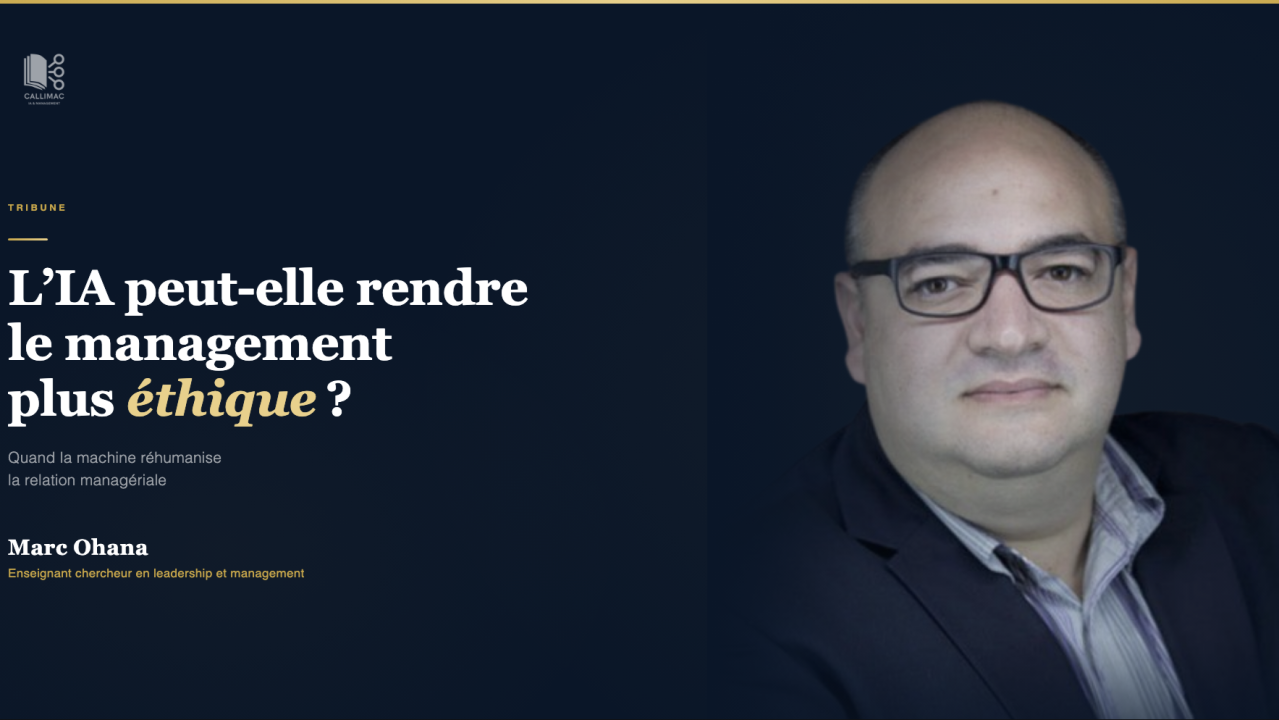
The question of ethics applied to artificial intelligence now occupies a central place in public debate. In the field of management and human resources, criticism is particularly fierce: AI would dehumanize human relationships, reduce individuals to data, and substitute algorithmic calculation for moral discernment. This feeling is understandable. It is even, in many cases, well-founded. When an AI is deployed to provide standardized, universalist responses, disconnected from the singular context of each employee, it produces exactly what its critics fear: a dehumanization of the professional relationship.
But this reading, while accurate in its diagnosis of misuse, must not obscure a more nuanced reality. An artificial intelligence designed with discernment, guided by a humanist vision of the managerial relationship, can on the contrary help make management more ethical. This is the thesis, deliberately counter-intuitive, that I wish to defend here.
Let us start with an observation widely documented by research in management sciences and occupational psychology. Management, particularly in France, is going through a deep crisis. Surveys converge: a significant proportion of employees report suffering at work, and managers themselves find themselves in difficulty. One of the structural causes of this suffering lies in the persistence of a managerial model inherited from an archaic conception of leadership. The "good manager," in this still largely dominant representation, is the one who knows, who decides, who settles matters. They are charismatic, omniscient, centered on their own capacity for action. This model of the providential leader, while it may have corresponded to certain organizational configurations, proves today profoundly ill-suited to employee expectations and contemporary workplace challenges.
It is precisely in this space that artificial intelligence can play an unexpected role. Not by "augmenting" the manager in the usual sense - making them more efficient, faster, more productive. But by helping them transform their posture. An AI whose response architecture is deliberately oriented toward the well-being and development of employees, rather than toward the manager's individual performance, becomes a tool for decentering. It invites the manager to step out of the self-referential logic of the all-knowing leader and adopt a posture of listening, questioning, and active benevolence.
This is exactly the approach we have adopted at Callimac. We did not seek to offer a "manager augmented by AI." We made the opposite choice: augmenting artificial intelligence with a humanist and ethical vision of management. Concretely, this means that every response, every suggestion, every support offered by the tool is designed to help the manager become aware of the need to be oriented toward their employees. The AI does not substitute for human judgment; it redirects it toward what should be at its core: attention to others.
This inversion of perspective is fundamental. It distinguishes two radically different conceptions of AI applied to management. On one side, an AI centered on the manager, which risks reinforcing the flaws of the traditional model by adding power to an already problematic posture. On the other, an AI centered on the employee, which becomes a lever for ethical transformation of managerial practices.
The question is therefore not whether artificial intelligence is ethical or not. The question is what intention we embed in its design. An AI without an ethical vision will reproduce and amplify existing biases. An AI conceived as an instrument of humanist transformation can, on the contrary, become one of the most powerful vectors for management finally oriented toward people.
It is time to reverse the paradigm. It is not AI that should augment the manager. It is ethics that should augment AI.